The European Digital Twin Ocean EOSC Node originated from the Blue-Cloud initiative, which de-facto piloted a marine thematic node to advance high-quality marine science in support of the European Digital Twin of the Ocean programme and its implementing facilities.
The Node federates multidisciplinary marine data, offering Virtual Research Environments (VREs) and Virtual Labs (VLabs), as well as supporting ocean research and FAIR-based collaboration.
Undertaken by leading European ocean and marine data and knowledge services, research infrastructures and e-infrastructures, the European Digital Twin Ocean EOSC Node facilitates collaborative research, offering computing, storage, analytical and generic services, orchestrated with a large variety of data resources for constructing, hosting and operating analytical workflows for specific applications.
To consolidate a marine thematic node in EOSC, and establish the technical and governance conditions that will guide the transition towards becoming a core component of the EDITO core infrastructure platform of the European Digital Twin of the Ocean.
FAIR data
The pilot Blue-Cloud project (2019-2023) and its successor Blue-Cloud 2026 (2023-2026) have made significant progress combining the interests of EOSC and the blue research communities, successfully reaching a large marine research audience. The European Digital Twin Ocean EOSC Node aggregates over 10 million datasets from EMODnet, CMEMS, and other infrastructures. It supports FAIR data and metadata via DD&AS, ensuring discoverability and accessibility.
Scientific use cases
Biological sequestration of carbon in the ocean
The scientific use case addresses the ocean’s critical role in mitigating climate change through biological carbon sequestration, a process by which marine microorganisms capture atmospheric carbon dioxide and store it in the deep ocean for centuries.
Despite its global importance for climate modelling, this mechanism remains poorly represented in current models, which still rely on simplified representations of marine ecosystems. The use case seeks to fill this knowledge gap by integrating genomic, environmental, and modelling data within a unified, open, and interoperable framework provided by the EOSC Federation.
Imaging data workflows on Galaxy
This science case on imaging data workflows on Galaxy demonstrates how a federated, open-access computational platform can transform the way imaging data are processed, shared, and reused across diverse scientific domains.
The use case leverages the Galaxy platform to integrate data from a wide range of imaging-based research fields—such as life sciences (microscopy), astrophysics (telescope data), climate science (satellite data), and marine science (underwater imagery)—into a unified analysis environment. The goal is to demonstrate that Galaxy can be integrated into the EOSC Federation’s common infrastructure to serve many disciplines simultaneously, allowing researchers to share workflows, reuse methods, and access powerful computational tools without needing specialised technical expertise.
Other use cases
- Facilitating Cross-Domain Web-Based Open Science through Virtual Labs (VLabs)
- Assessing Transboundary Processes and Connectivity
- Carbon Sequestration and Plankton Dynamics
- Eutrophication Assessment – EOV Data Harmonization and Climatology Workbench
- A pilot for EOSC nodes collaboration: Integration and testing of FAIR-EASE components within Blue-Cloud’s Virtual Research Environment
- Enhancing Marine Research through Collaborative Services: A Synergy Between the Blue-Cloud Marine Thematic Node and the Italian Node
Status
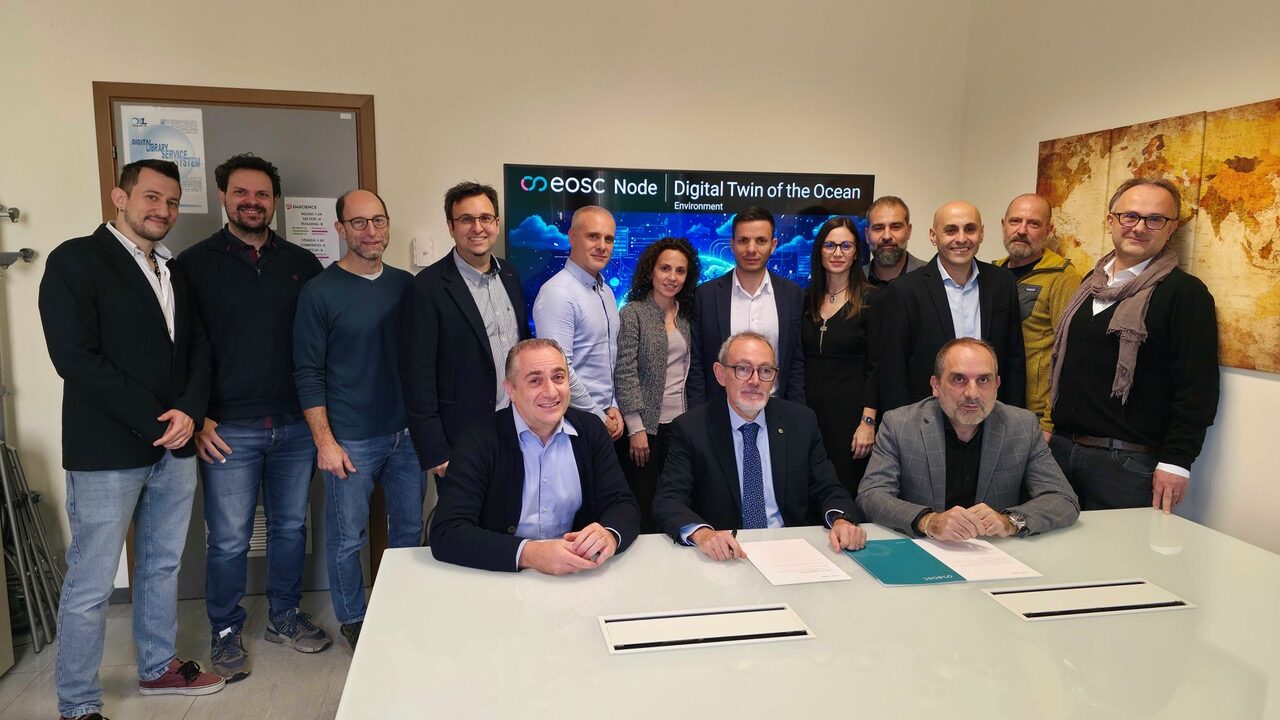
Candidate thematic EOSC Node (Build-up phase)
Deliverables
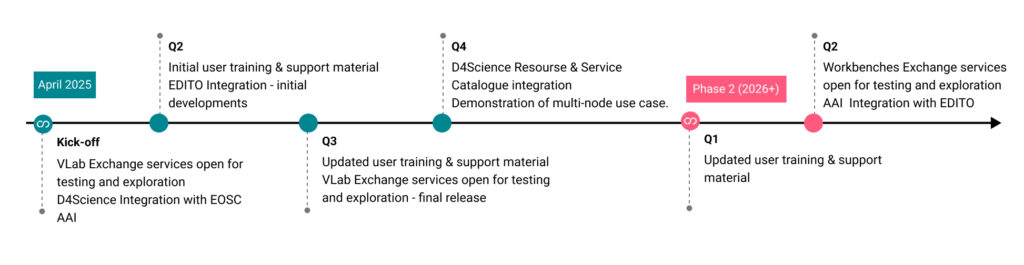
- IT Governance documentation (CNR)
- Data protection policies (MARIS)
- Operational quality plans (CNR)
- Stakeholder engagement strategy (Trust-IT)
- Service component roll-out and APIs (CNR)
Technical status
Completed
- Federated AAI (OIDC/UMA2)
- Onboarded service catalogues
- Application workflow management (VLabs)
- Service monitoring (FitSM-aligned)
- Service and research product accounting
- Order management
- Helpdesk
- Management system (D4Science Service Registry)
Interactions with other EOSC Nodes
How to access the Node
Rules of Participation
The European Digital Twin Ocean RoP policy is aligned with EOSC Federation rules, and includes:
- FAIR-based
- Federated AAI
- Open Science interoperability
Access points
- Via home page (blue-cloud.org/eosc-node-digital-twin-ocean)
- Via Blue-Cloud VRE (blue-cloud.d4science.org)
- Via federated AAI
Node capabilities
Federated services
- VRE
- VLabs
- DD&AS
Data repositories
- EMODnet
- CMEMS
- other BDIs
Compute and storage
D4Science infrastructure
Spatial Data Infrastructure
- GeoNetwork
- GeoPortal
- GeoServer
- THREDDS
VRE
- JupyterHub
- RStudio
- Galaxy
- Collaborative Computing Platform services
File sync-and-share
Workspace
Coordinating organisation

Node organisation
Coordinator
Pasquale Pagano (CNR)
Technical Coordinator
Dick Schaap (MARIS)
Stakeholder Engagement and Dissemination Coordinator
Sara Pittonet Gaiarin (Trust-IT Services)
Operation Manager
Massimiliano Assante (CNR)
Security Officer:
Tommaso Piccioli (CNR)
Infrastructure Manager
Andrea Dell’Amico (CNR)
Contributing organisations
MARIS, Trust-IT, iFREMER, SSBE, MOI, VLIZ, CMCC, EMBL, KNMI, CINECA, GRNET, NUBISWARE, SU, UvA, FORTH, IRD, OGS, HMRC, EMSO-ERIC, ETT, UWA, ULiège, EGI, INGV, SOCIB, EUROGOOS, SMHI, EMBRC-ERIC, IH, SIOS, IOPAN, HUB OCEAN, IEEE, OceanScope, Pokapok