The Data Terra EOSC Node is the French national research e-Infrastructure for the Earth System, biodiversity and environmental scientific domains supported by several national research-performing organisations and universities.
Data Terra federates five Earth domain-oriented data and services hubs: i) atmosphere (AERIS); ii) oceans (ODATIS); iii) land surfaces (THEIA); iv) solid earth (FORMATERRE); and v) biodiversity (PNDB). In addition, Data Terra develops cross-cutting and multidisciplinary services with a specific focus on satellite observations. Data Terra arranges a comprehensive and complementary national landscape of thematic infrastructures and thus contributes to other European hubs and initiatives as data and service provider. As an EOSC Node, Data Terra provides single sign-on to high-quality, trusted, FAIR and AI-ready multidomain data for the Earth system. It also provides cross-domain data analysis workflow and VREs enabling multidisciplinary collaboration leveraging federated resources.
To contribute to the EOSC Federation as a thematic e-Infrastructure Node, providing access to high-quality, FAIR and trusted, multi-domain data on Earth system, climate, environment, and biodiversity. To enable technical and semantic interoperability, and provide VREs and scientific workflow analytical tools.
FAIR data
The Data Terra EOSC Node makes high-quality, trusted and FAIR AI-ready multi-domain data and multi-source data (space, airborne, in-situ, models, omics). Metadata harmonisation, technical and semantic interoperability, federated resources catalogues.
Scientific use cases
Biological sequestration of carbon in the ocean
The scientific use case addresses the ocean’s critical role in mitigating climate change through biological carbon sequestration, a process by which marine microorganisms capture atmospheric carbon dioxide and store it in the deep ocean for centuries.
Despite its global importance for climate modelling, this mechanism remains poorly represented in current models, which still rely on simplified representations of marine ecosystems. The use case seeks to fill this knowledge gap by integrating genomic, environmental, and modelling data within a unified, open, and interoperable framework provided by the EOSC Federation.
Imaging data workflows on Galaxy
This science case on imaging data workflows on Galaxy demonstrates how a federated, open-access computational platform can transform the way imaging data are processed, shared, and reused across diverse scientific domains.
The use case leverages the Galaxy platform to integrate data from a wide range of imaging-based research fields—such as life sciences (microscopy), astrophysics (telescope data), climate science (satellite data), and marine science (underwater imagery)—into a unified analysis environment. The goal is to demonstrate that Galaxy can be integrated into the EOSC Federation’s common infrastructure to serve many disciplines simultaneously, allowing researchers to share workflows, reuse methods, and access powerful computational tools without needing specialised technical expertise.
Other use cases
Volcano Space Observatory: real-time and retrospective volcanic event monitoring with satellite data and multi-domain Earth system data (atmosphere and solid earth)
Deliverables
- IT Governance documentation and technical architecture
- Policies and procedures (IT security plan, risk registry, SLAs)
- Operational reviews, verification, and QA reports
- Stakeholder and community engagement strategy (dissemination, training)
- Thematic tools and services (VREs, cross-domain demonstrators)
- Sustainability and exploitability plan (technical and financial)
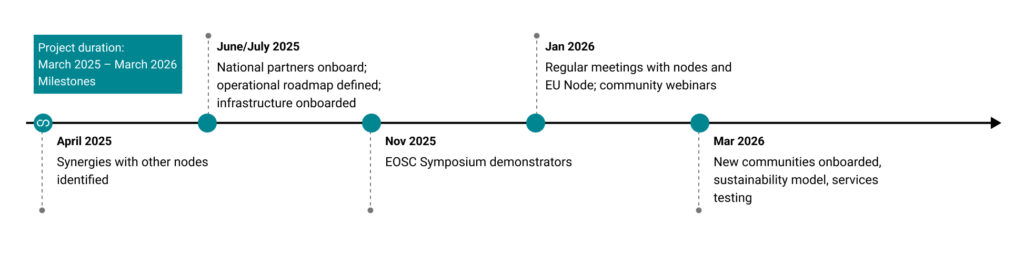
Technical status
Completed
- Federated AAI (Keycloak SSO, EduGain, ORCID, EOSC MyAcessId
- Onboarded service catalogues (resources federation, registries
- Application workflow management (Galaxy
- Management system (FitSM-aligned, IT governance, ISO-compliant policies)
Planned
- Service monitoring
- Service and research product accounting
- Order management
- Helpdesk
Interactions with other EOSC Nodes
How to access the Node
Rules of Participation
The Data Terra policy:
- Is aligned with EOSC Federation rules;
- Supports GDPR, Open Science policies, quality standards, and provenance/trust frameworks.
Access points
Via Data Terra portal (EOSC Node services to be integrated during build-up phase). Access via federated AAI with EduGain/ORCID/EOSC AAI/MyAccessId includes access to VREs (Jupyter, Galaxy) and resources catalogues.
Node capabilities
Federated services
- AAI
- Registries
- Metadata
- Workflows
Data repositories
National and European thematic hubs (Earth, climate, biodiversity)
Compute and storage
- GENCI/EuroHPC
- France Grilles/EGI
- National data centres
VRE
- Galaxy
- Jupyter notebooks
File sync-and-share
Integrated with EUDAT B2DROP and OwnCloud (planned)
Other
- Knowledge graph
- Citizen science gateway
- Monitoring and accounting tools
Coordinating organisation
Node organisation
Coordinator
Alessandro Rizzo (Data Terra RI)
Legal entity representative
Legal entity representative: Nicolas Arnaud, CNRS-INSU Director
Operation Managers
Karim Ramage (CNRS), Erwan Bodere (Ifremer), Jérôme Pansanel (CNRS)
Security Officer
Mourad Guermache (CNRS)
Scientific Officer
Jean-Pierre Vilotte (CNRS)
Legal Officer
To be confirmed
Contributing organisations
CNES, Ifremer, INRAE, IRD, Meteo france, IGN, MNHN, BRGM, CEREMA, CIRAD, CEA, École Polytechnique, Réseau des universités Marines, EPHE-PSL, IPGP, AgroParisTech, ONERA, Observatoire de la Côte d’Azur, Observatoire de Paris, OFB, Région Hauts de France, SHOM, Université Clermont Auvergne, Université de Bretagne Occidentale, Université de Franche Comté, Université de Lille, Université de Montpellier, Université de Paris Saclay, Université de Rennes, Université de Strasbourg, Université de Grenoble Alpes, Sorbonne Université, Université Toulouse III-Paul Sabatier.